PGM Diagrams
A reading practice on the Greek Magical Papyri that treats a spell as a procedure rather than a text: asking what it takes in, what it emits, what order its operations run in, and what the surviving papyrus does not account for.
The spell that anchors it
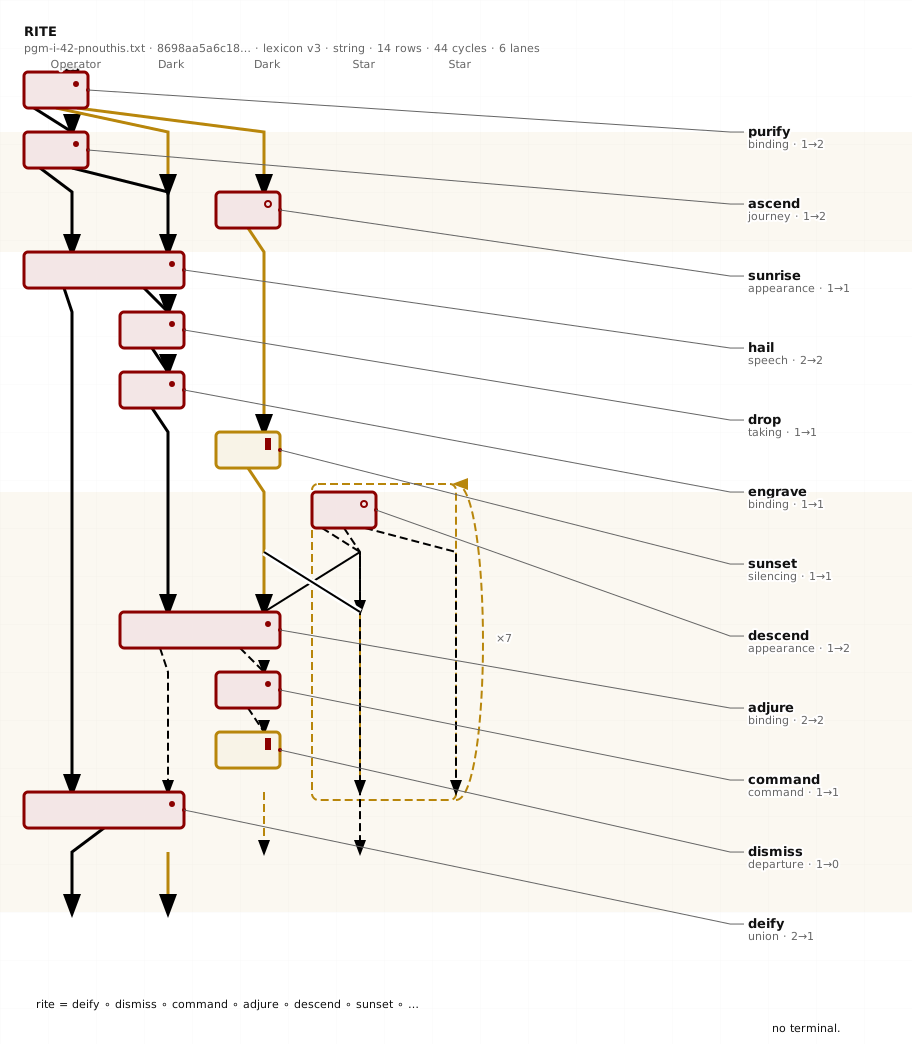
PGM I.42–195 (the Pnouthis spell) is a rite for acquiring an assistant, the paredros. It is the one that has been carried furthest: formalised as a monoidal category and rendered as a string diagram in Diagrammatic Immanence, where the same object also emits the score, and then used as the frame for Order of the Meridian, where the assistant summoned is a machine and the week closes by giving it license to depart.
Sphinx
The diagrams and the readings around them run through Sphinx, a publication and reading series, which is where the work is argued in public rather than only drawn. A reading series is the right venue for this: a diagram of a rite is a claim about what the rite does, and a claim wants a room that can push back on it.
What the drawing is for
Drawing a rite as a diagram makes two things checkable that prose hides: the order of operations, and the typing: what each step actually consumes and produces. Once a spell is in that form, the parts that do not compose become visible, and so do the parts that were never written down.
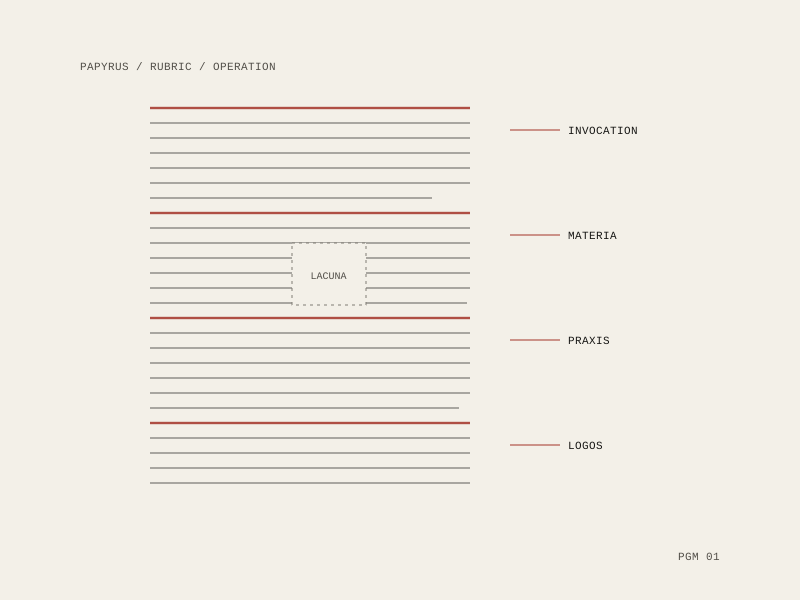
The lacunae are left as lacunae. A gap in the papyrus is a fact about the source, and filling it silently would make the diagram say more than the manuscript does.